Over a decade after it was originally conceived, the ambitious InterContinental Shanghai Wonderland Hotel is opening to the public. Located in an abandoned quarry in Songjiang, about 30 miles from the city center, the 337 room hotel features panoramic views and several floors that are submerged underwater.
JADE+QA, under the guidance of Martin Jochman, designed the concept and facade. The award-winning design calls for 19 floors, 17 of which plunge down into the depths of the quarry below ground level. Two of the 17 underground floors are actually submerged in a 33-foot-deep aquarium.
One of the most stunning architectural features of the complex is the glass “waterfall” that spills down the side of the quarry and houses an atrium. A glass “waterfall” runs the height of the 19-floor building, housing an indoor atrium.
The InterContinental Shanghai Wonderland Hotel is located in an abandoned quarry and includes an adventure sports center. The InterContinental Shanghai Wonderland is accepting reservations for November 20, 2018 onwards with prices starting at ¥3,380 ($487).
Widely regarded as the hallmark of fine dining, the Michelin star is arguably one of the most sought-after awards for many chefs, and is the sign of dining excellence. There are currently five restaurants in the UK which hold three Michelin stars and Restaurant Gordon Ramsay is one of them.
Gordon Ramsay’s first solo restaurant that opened in 1998 and later in 2001, earned him his first three-Michelin star that made him the first Scottish chef to have won the ultimate status. Over the years, Ramsay has transformed from a chef to a celebrity, internationally renowned and holding a number of Michelin stars, Ramsay has opened a string of successful restaurants across the globe, from Italy to the United States. However, this Restaurant Gordon Ramsay is the beginning of all the successful stories. In 2015, Matt Abé was appointed Chef de Cuisine of the restaurant.
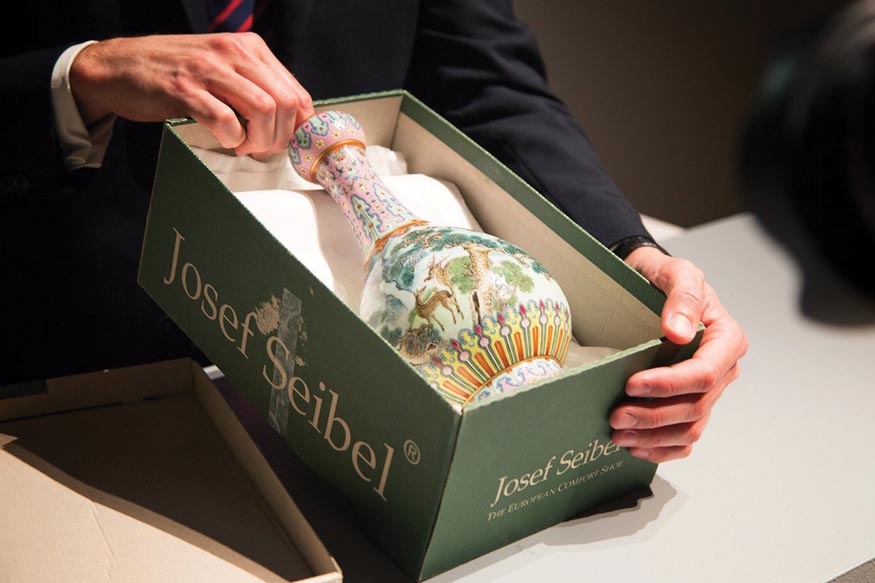
When auction houses are hammering away incredible prices on arts and antiques, it is normal that galleries would take advantage of the situation and tag items with a higher price. Hence, making owners with the knowledge of the product demand high or sometimes unreasonable premiums. Eventually, this circle will lead to a spike of fakes, imitations and forgeries. In modern technology today, news travels at high speed through the internet and social media world. It is not difficult for owners, collectors, sellers and even criminals to know what is of high demand in the current market. News like an 18th century Chinese vase found in a shoebox in an attic in France that sold for USD 19 million caused a big commotion among collectors, motivating them to embark on a hunt for such pieces hoping to have the same luck.
An 18th century Chinese vase found in a shoebox in an attic in France sold for 16.2 million euros (£14.3 million) at auction in Paris
Image courtesy of news.ro
In a simple economical and business environment, demand dictates supply. What if the demand for genuine pieces are high but there is not enough supply? Ultimately, this will require an alternate source of supply to satisfy the market. Imitations or replicas of old pieces are thus produced and sold as new pieces for those who only seek nice affordable pieces for decoration purposes. However, unethical dealers would produce fakes and pass them off as genuine pieces with an intention to cheat the buyer. In short, replicas are legal, but if one tries to pass off a new piece as an antique it is considered a criminal offense.
The business of fake antique pieces is actually one of the fastest growing businesses in the world. In 2014, a report by Switzerland’s Fine Art Expert Institute (FAEI) stated that at least half of the artwork being circulated in the market is fake. Al Jazeera reported in 2015 the fact that buyers from China spent more than USD 5.5 billion on Chinese art and antiques in 2014, yet Sotheby’s Asian art expert, Nicolas Chow, said that: “Virtually 99.9% of what you see in the art world is wrong.” This alone poses as a rather alarming issue. Stories of collectors having porcelain makers in Jingdezhen use their genuine antique pieces as reference to duplicate high quality copies which they then place in smaller auction houses in America or Europe ‘claiming provenance’ is also a shock to hear. Some of the most recent cases in 2018 include incidents such as when the Museum of Fine Arts in Ghent was found exhibiting 26 fake works by Kazimir Malevich and Wassily Kandinsky and the Telegraph’s report on how there was only one genuine work of Amedeo Modigliani among a collection of 21 fake paintings that were on exhibition at Genoa’s Palazzo Ducale.
The fake market is now so common across the world that there is actually a museum exhibiting fakes. The Museum of Art Fakes in Vienna that opened in 2005 invited some of the master art forgers to exhibit their creations. Among them were German artist, Edgar Mrugalla, a self taught expert in copying works of Rembrandt, Picasso and Renoir. He has painted more than 3500 pieces by the time he was 65, jailed and eventually released to work for authorities to help uncover dubious artworks. On the other side of the continent, there is a famous art village called Dafen in China that produced an estimate 60% of the world’s oil paintings a few years back. People that worked in the studios and galleries were like art processors with jobs of ‘xeroxing’ famous works of artists no matter dead or alive as long as there were people in demand of the art piece. However, the Chinese government eventually intervened because cheap fakes were no longer viable in the rapid rising cost and e-commerce environment and original works were encouraged. This has however forced many art forgers to take higher risks to forge more expensive pieces in order to survive.
Although authorities around the world are clamping down on syndicates and master forgers in the art field, one must understand that to do so it is extremely difficult due to the efficiency of high tech scanners and printing machines these days. The similarity of the fake piece to the original piece is so precise that some experts hesitate on the originality of the piece and would play safe by commenting things like: “… to my best knowledge but the final decision still lies with the purchaser.” Every involved party is trying their best to keep a distance from such situations to prevent the possibility of being sued for negligence.
All in all, the business of forgery is a multi billion business in the world today. If one does not have the proper knowledge, financial means and fears being cheated on, it is highly advisable to stay away from becoming a collector.







 EZ AUSTRALIA.NEWS