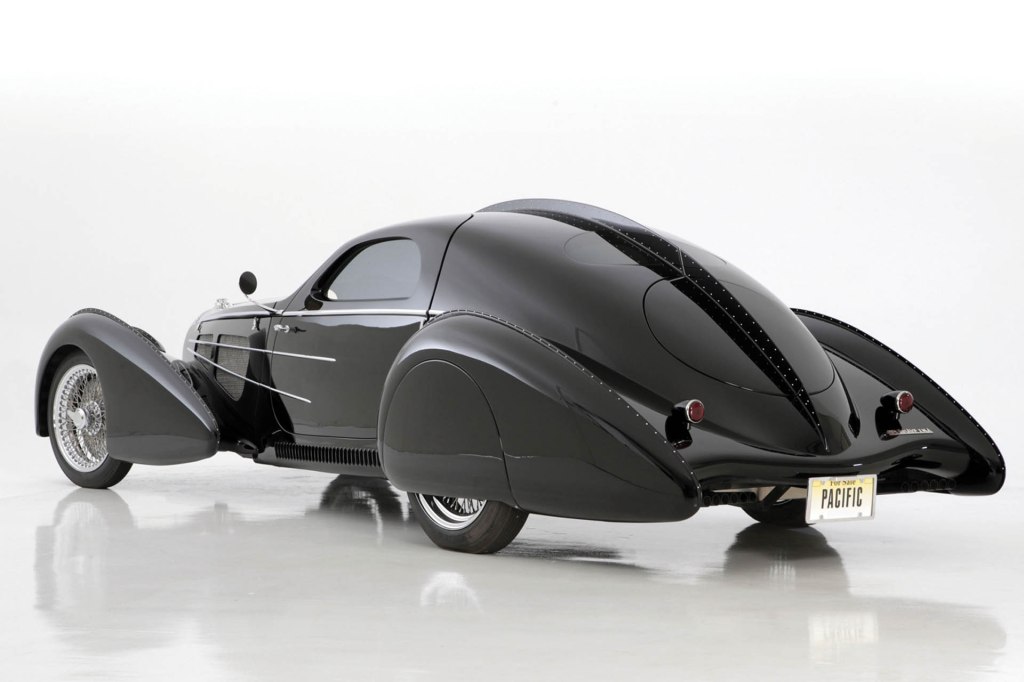
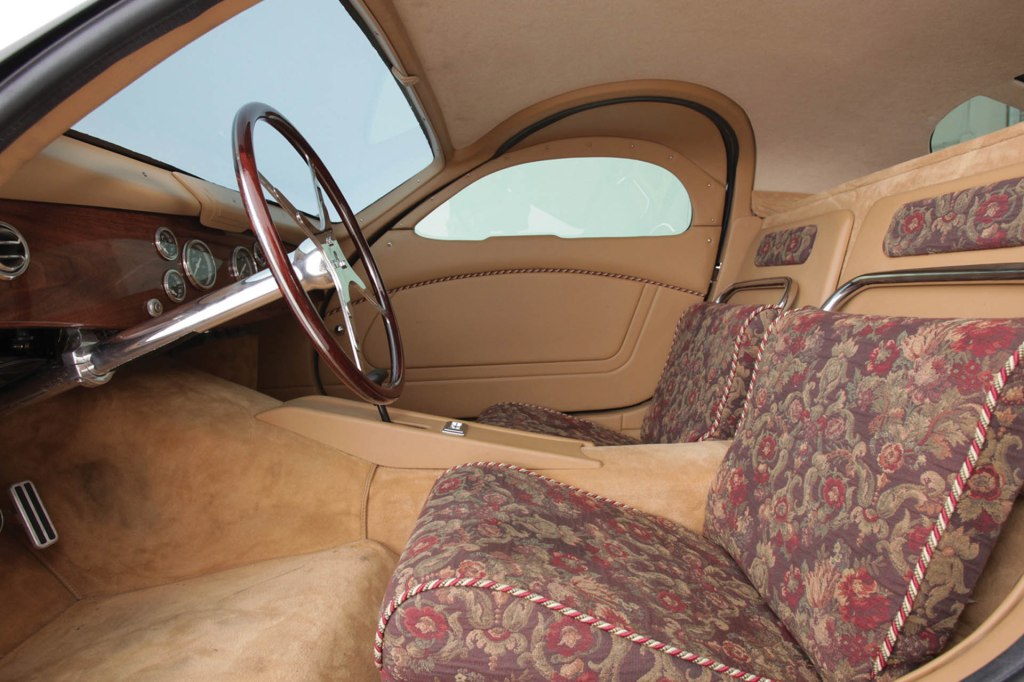
The Pacific by Delahaye USA 最精致的复刻品

There are a few boutique car manufacturers but not all are capable of producing a vehicle that one can made to order and turn heads whilst on road. The Delahaye USA was named in tribute to Emil Delahaye, the famous automobile manufacturer in Tours, France in 1879. However this company in the United States is not connected to the original Delahaye GFA or The Delahaye Club Of France that a loyal group of Delahaye fans have registered. 

The Pacific by Delahaye USA is a stylized re-interpretation of Ralph Lauren’s famed 1937 Type 57S Bugatti Atlantic. The Pacific was a tribute and never an exact replica of Atlantic but with the intention to create the most beautiful Atlantic that was never built until today. The goal was to build a modern, stylized tribute to the 57S that still respected Jean Bugatti’s original version. 

古董车制造商不多,但并非所有人都能生产可以度身定制并在路上让人频频回头注目的汽车。Delahaye USA的名字是为了纪念1879年在法国图尔市制作汽车的著名汽车制造商Emil Delahaye。 不过这家来自美国的车厂和原产地的Delahaye GFA及Delahaye 官方车友俱乐部并没有任何关系。

这款The Pacific by Delahaye USA车型是Delahaye USA参照设计师Ralph Lauren最有名的藏车1937 Type 57S Bugatti Atlantic的车型重新诠释的一款车型。这是至今最精致的复刻品,也是现代风格的“The Pacific”向原始版“57S Bugatti Atlantic”的致敬。

Image(s) courtesy of http://www.delahayeusa.com

The New Food Map For Digestive Disorders

by Dr. Mecherl Lim 

MD (MA) Naturopath (ND), Holistic Kinesiology

There’s a new acronym in the dieting world: FODMAP. It’s  an acronym that makes life easier for anyone discussing this particular diet, because the words represented by the acronym are so difficult to remember, let alone pronounce.  FODMAP stands for fermentable oligosaccharides, disaccharides, monosaccharides and polyols.

IBS RELIEF

One of the reasons this new diet is getting so much attention is that it seems to help those who experience the symptoms of irritable bowel syndrome (IBS). Millions of people suffer from digestive disorders, and up to 20 per cent suffers at some time with IBS

WHAT IS IBS?

While the word “bowel” is built into the name, IBS involves pain and discomfort anywhere in the abdomen, and includes such varied symptoms as diarrhoea, constipation, painful wind, belching, flatulence and bloating. If left untreated, over time it can lead to dehydration, nutrient deficiencies, social discomfort and could contribute to some forms of cancer.

WHAT CAUSE IBS?

Experts believe that IBS is the result of dysfunction in the muscles or nerves controlling the  organs of the gastrointestinal tract, which is  a lot more complex than it might first appear. A system of nerves runs the length of the digestive tract starting at the oesophagus and ending at the anus.  In fact, the number of nerves in the gastrointestinal  tract is exceeded only by the number  present in the spinal cord and brain!

WHAT ROLE DOES DIET PLAY?

While some experts ponder the source of the dysfunction, others are focusing on the role of diet in producing the symptoms associated with IBS. Poor digestion, malabsorption of dietary sugars (lactose from dairy and fructose from fruits) and food chemicals have often been considered triggers for IBS symptoms. 

Similarly, while dietary fat helps food and wind to move slowly through the stomach and small intestine of healthy individuals, it seems to really slow down food and wind transit in those with IBS. New research also suggests non coeliac gluten intolerance may play a role in those who suffer with irritable bowels.

One of the major complaints associated with IBS involves wind production. For example, IBS sufferers report more  wind, as well as wind that takes longer to dissipate from the small intestine that those without IBS.

As a result of the wind build up, bloating causes an increased abdominal size throughout the day, leading to discomfort and possible embarrasment- not to mention a wardrobe full of unattractive clothing with elasticized waistbands! 

Image(s) courtesy of Freepik.com

Frozen Shoulder

by Dr. Tan Boon Cheong

MBBS (MU),. MS Ortho (MU)

The shoulder is a region that commonly gives rise to pain and immobility. A common shoulder problem in orthopaedic practice is frozen shoulder or adhesive capsulitis. Frozen here does not mean cold temperature but it carries the meaning of the inability to move the shoulder joint in almost all directions as the disease progresses. Frozen shoulder is debilitating and will affect the daily activities of the patient. Frozen shoulder tends to heal over time, but full recovery may take up to three years.  

It generally affects people between the age of 40 to 60 and more in females. The causes of frozen shoulder are not fully understood but there are a few factors which may present higher risks.  Prolonged immobilisation after shoulder injury or surgery is one of them. Thus, early mobilisation is important. Diabetic patients (10% to 20%) are more prone to the ailment.  They tend to have greater degree of stiffness and longer duration of the problem. Other medical conditions such as heart disease, thyroidal imbalance or Parkinson’s are linked to this malady as well. 

The main symptoms are pain and stiffness. The pain is usually dull or achy in nature, typically in the outer part of the shoulder. Some patients may feel this pain at the upper arm. It gets worse at night, making sleep difficult. Symptoms of frozen shoulder can be categorised in three phases namely freezing, frozen and the thawing phase. Basically, the pain intensity slowly builds up to a stiffness that will lead to a debilitating phase before a slow recovery over time.  

Diagnosis of frozen shoulder is based on clinical history and physical examination. Some imaging may be ordered to rule out other diagnosis if the history and examination are inconclusive.  

Treatment of frozen shoulder is usually conservative with medication and physiotherapy. Shoulder joint injection with corticosteroid and joint distension with the injection of sterile water may sometimes be applied to reduce the symptoms. Shoulder joint manipulation under general anaesthesia can help in loosening the joint but is rarely needed or practiced. Surgery for frozen shoulder is seldom necessary. 

Image(s) courtesy of Freepik.com